
Book Review: Islands in the Mist by J. M. Hofer
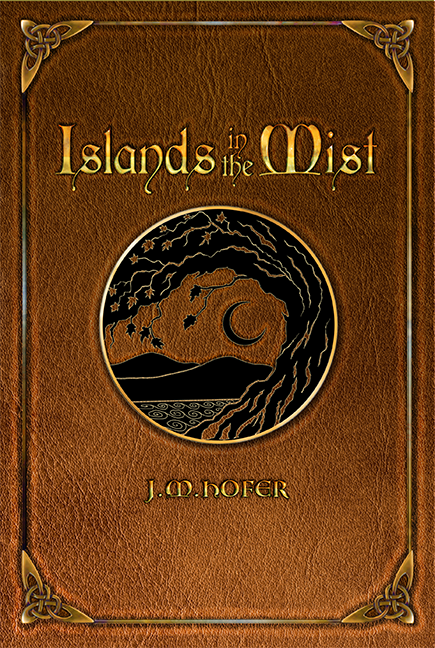
J. M. Hofer weaves a complex, compelling story based on ancient Welsh legends, making the characters – while convincingly historically accurate—as relatable and sympathetic as modern heroines and heroes.
The world she evokes in Islands in the Mist is a matriarchal society, presided over by the deity The Great Mother, whose handmaidens are a colony of women with supernatural powers, living in isolation on a remote island.
The book opens with the visit of a stranger to a farm on the mainland, home of Lucia, widow of a Roman nobleman, and her helpers, Aveta and Aveta’s young son, Gwion. Both Gwion and Lucia have unearthly abilities, Lucia’s to see the future, and Gwion’s to communicate in the language of animals, plants, and trees. The visitor is a large, handsome man named Bran who warns of recent attacks in nearby villages by strange beings who have been killing and devouring victims in gruesome ways.
After Bran’s departure, Lucia has a vision of her home being burned and pale figures slinking in the dark, searching for human prey. When she tells Aveta of her vision, the other woman says the three of them must depart for the island where the Sisterhood reigns. She then tells Lucia that she, Aveta, is the sister of Lucia’s departed mother, and a daughter of the High Priestess of the Sisterhood.
The current plague of attackers is the work of Cerridwen, the oldest sister of Aveta and Lucia’s mother. Cerridwen has left the island, taking the Sisterhood’s cauldron with her. She has used the supernatural power of the cauldron to reanimate dead bodies, creating a numberless army to give her control of the four kingdoms in the realm. Bran becomes the leader in the fight against Cerridwen’s plot. In the process, he and Lucia fall in love.
The final battle sees the sacrifice of two of the book’s most beloved characters as the army of warriors from the four kingdoms rise up against Cerridwen and her undead minions. It is a dramatic, suspenseful ending, and Hofer brings the book to a mystical conclusion.
Her writing is polished, lyrical, and lovely. Hofer especially excels at descriptions of natural beauty. The details of ancient Celtic life are vivid and convincing. Unlike many historical novels, this one had no anachronisms in speech or description to trip up the reader. Hofer sustains a steady pace throughout this epic tale, which is no mean feat.
My criticisms of the novel are minor: First, there are a great many characters with unusual names for the reader to keep track of. A chart of relationships – especially of the priestess, Lady Rowan, her daughters Aveta, Cordelia (Lucia’s mother), and Cerridwen, and Rowan’s granddaughter, Lucia, would help a lot. Too, the leaders and warriors in the book’s several realms are hard to keep straight.
Also, the book begins with Lucia and creates the expectation that Lucia will be the protagonist, but, although Lucia reappears throughout the book, she’s not a major character and another woman becomes the focus of the conclusion.
Last, the husband Lucia believed to be dead, the Roman Camulos, returns to her briefly, but is greatly changed for the worse and she wonders if he’s possessed. The implication is that he may be under Cerridwen’s spell, having been raised from the dead. He disappears from the narrative and the mystery of his altered nature is never solved.
None of this detracted from my admiration for Hofer’s achievement, creating a rich, imaginative book peopled by characters who will win readers’ hearts. The fact that there are four more books in this series makes her accomplishment even more impressive.
